Three controls, three different decisions
A campaign URL, an obsolete article and an internal search result may all look like “extra pages.” That description hides the decision you need to make. The campaign URL might remain useful to visitors while representing the same main content. The obsolete article may need to send people to a replacement. The search result may serve readers without needing its own place in a search index.
Canonicals, redirects and noindex instructions address different situations. Choose among them by writing down what the URL should do for a visitor, whether it should remain accessible and which version of the content you prefer search engines to represent. A technical setting cannot resolve an unclear editorial purpose.
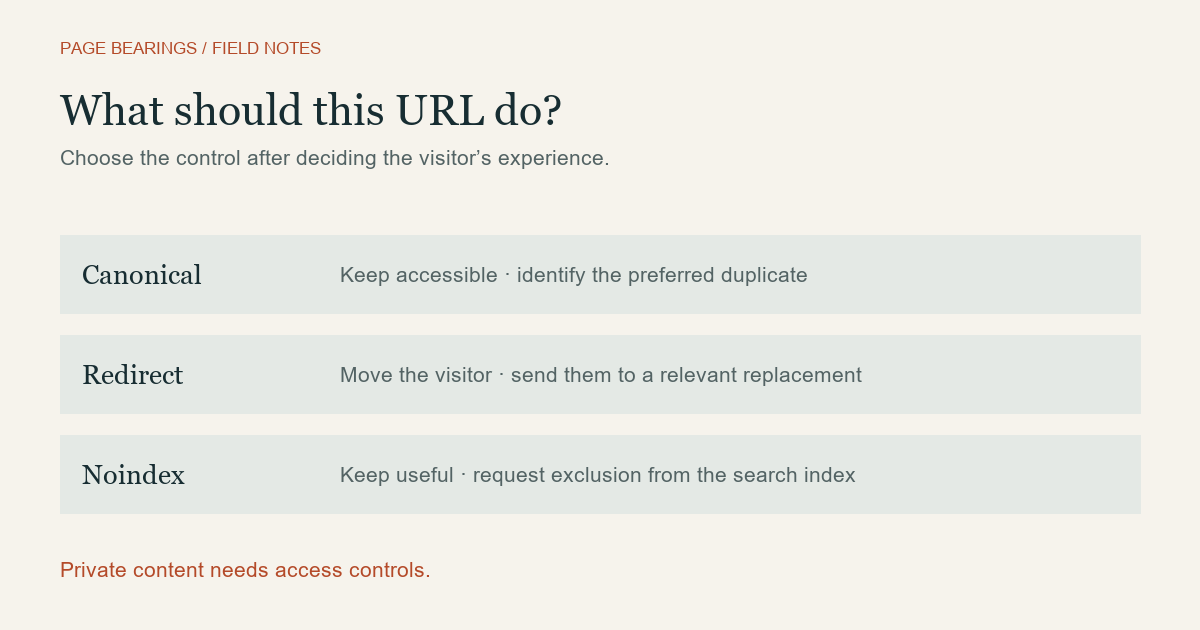
Keep an accessible duplicate: consider a canonical
Suppose an article is available at a clean address and at an address containing a campaign parameter. The content is substantially the same, and visitors using the campaign link should still reach the article. A canonical can identify the preferred version without moving the visitor to another page. It is a signal about representative content, not a command that forces a search engine to select that URL.
For a simple editorial site, the clean page will usually point to itself as its preferred version. Parameter versions can point to that same clean address. Confirm that the target is accessible and actually represents the same material. Pointing unrelated pages to a popular homepage does not make the homepage a meaningful representative of them.
Google’s canonicalization documentation describes signals such as canonical annotations, redirects and sitemap inclusion. The practical checks below are our implementation workflow: keep these signals consistent and investigate contradictions rather than adding more markup in the hope that one instruction wins.
Replace an old location: consider a redirect
If an article moves from an old slug to a new slug and the old address has no continuing purpose, a permanent redirect can send visitors to the new location. Unlike a canonical annotation, the redirect changes the navigation. A bookmarked old link should take the reader to the replacement rather than show a second copy of the article.
Map the old URL to a relevant destination. An article about form delivery should not automatically redirect to the homepage just because the old page was removed. If there is no appropriate replacement, returning a genuine not-found response may be more honest than sending readers somewhere unrelated. The editorial decision comes before the redirect rule.
Check the entire route. An old HTTP address might first redirect to HTTPS, then to a different hostname, then to a changed slug. Each extra step adds complexity and another possible failure. Link to the final address from your own site, and simplify chains where your hosting and CMS configuration allow it. Avoid changing server rules without recording the previous configuration.
Keep a utility page out of the index: consider noindex
An internal search results page can help a visitor find articles without becoming a page you want represented independently in external search. A noindex instruction can express that preference while leaving the page accessible. It is different from preventing a crawler from requesting the page in the first place.
That distinction matters. Google’s robots.txt guidance explains that crawling restrictions are not a reliable way to remove a URL from search results. If a crawler cannot request a page, it may not see a noindex instruction on that page. Private information requires access controls; neither robots.txt nor a canonical is a security boundary.
Use the same reasoning for thin tag archives, duplicate date archives and other low-value indexes. Do they offer a useful distinct view? If the answer is yes, an archive may deserve editorial attention. If the answer is no, indexing every generated view can create unnecessary clutter. Do not apply noindex to an important article merely because it receives little traffic.
Work through a small URL inventory
| Illustrative URL | Visitor’s need | Likely decision |
|---|---|---|
| /guide/?campaign=autumn | Read the same guide | Keep accessible; canonical to the clean guide |
| /old-guide/ | Reach the replacement guide | Permanent redirect to the relevant new URL |
| /?s=guide | Search the publication | Accessible search results with noindex |
| /retired-without-replacement/ | Understand that the page is gone | A genuine 404 or 410, with helpful navigation |
These are examples, not rules to paste blindly into a server. A campaign parameter may change the content substantially. An old guide may still answer a distinct historical question. Record the intended behavior for each URL family and inspect representative pages before applying a broad rule.
Verify what an anonymous visitor receives
Open the URL outside the administrator session. Record the response status, the final address after redirects, the canonical annotation and any robots directives. Inspect the HTML actually returned by the public server. A setting in an SEO dashboard is useful evidence of intent, but it is not proof of the delivered result.
For a canonical, look for one absolute preferred URL and check that it returns the expected page. For a redirect, verify the status and final destination. For noindex, verify that the instruction is present and that crawling access does not prevent it from being seen. Check a few ordinary articles as controls so a broad template change has not affected the whole site.
If you use caching, repeat the public check after invalidating the relevant cache through the product’s normal controls. Do not assume that a logged-in view matches the cached anonymous response. Our internal-link checks offer a useful companion: navigation should point to final, relevant destinations too.
Keep a record of the decision
A URL register only needs a few fields: old address, intended destination or behavior, reason, date changed and verification result. Add an owner for changes that depend on the server. This makes later diagnosis easier when someone asks why a page disappeared or why a bookmark now leads elsewhere.
Do not promise an indexing outcome immediately after changing the setting. Search engines may need time to revisit and process the page, and they can make their own canonical choices. The part you can verify now is the public response and the consistency of your signals. The part you should monitor later is how the search system interprets them.
The right control follows the URL’s job. Keep duplicates coherent, move visitors when a location has truly changed, and keep utility pages useful without making every generated view an indexable destination. Review those decisions when the content changes, not only when a technical audit flags them.