Begin with a decision you expect to make
What would you do differently if your dashboard changed? If the answer is unclear, another chart will not help. A measurement plan starts with a decision: whether a guide needs revision, whether a contact route works, or whether visitors can complete a particular task. It then identifies the smallest set of observations that can support that decision.
For an independent publication, useful outcomes might include finding a relevant article, using a worksheet or successfully submitting an editorial message. These are different from page views. A page view confirms that a page was recorded by the measurement system under its conditions. It does not establish comprehension, satisfaction or a completed task.
The plan below is an illustrative method for a small site. It does not require installing a particular analytics service, and describing an event does not mean that service is active on this publication. Start with the questions and your actual privacy constraints, then choose the collection method.
Choose outcomes before proxies
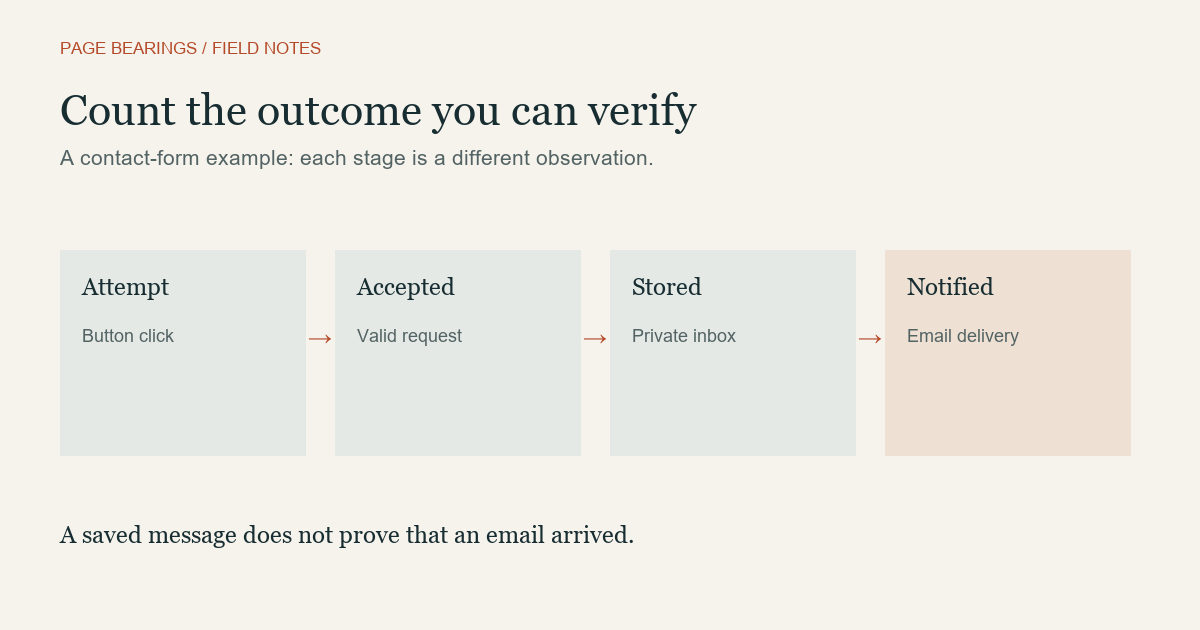
Suppose the contact page’s job is to receive editorial corrections. A useful outcome is a valid message saved where the operator can retrieve it. A button click is only an attempt. A browser success message is useful evidence, but it should correspond to server-side storage or confirmed handling. Otherwise you may be measuring a reassuring interface while missing the message.
For a reference article, completion is harder to observe. You can record a worksheet download or a click to a relevant next step, but those remain proxies for usefulness. Time on page is also ambiguous: a long visit may indicate thoughtful reading, an open browser tab or difficulty finding the answer. Name the proxy and its limitation in the plan.
Use one primary outcome for each important page family. Supporting measures can help explain it, but they should not compete with it. A guide page might have a primary task of helping readers complete a diagnostic check, with search entrances and reference-link use as supporting observations. Resist turning every scroll, hover and click into an equally important signal.
Write an event contract
An event contract defines exactly when a record should be created. For a saved contact message, the condition could be “the server has accepted a valid submission and created a private inbox entry.” The contract should distinguish validation errors, spam rejections, repeated attempts and successful storage. That precision prevents different developers from implementing the same event name differently.
Record the event name, trigger, permitted fields, exclusions, collection source and known limitations. Do not include message bodies, email addresses or names in an analytics event. They belong in the private operational workflow when genuinely needed, not in a general reporting stream. Keep the event’s useful context minimal: perhaps the form type and success state, depending on your chosen system and privacy requirements.
If you use Google Analytics, its recommended events documentation includes events for tasks such as requests for information. Check the defined meaning and parameters before adopting one. A name that sounds convenient is not enough; your trigger needs to match the meaning you intend to report.
Keep a one-page measurement register
| Decision | Primary observation | What it cannot prove |
|---|---|---|
| Is the contact route reliable? | Valid message saved in the private inbox | That an email notification reached its destination |
| Does the guide attract the intended audience? | Relevant query and landing-page patterns | That each reader completed the task |
| Can readers find the next reference? | Use of a clearly named internal link | That the destination answered their question |
| Should an article be revised? | Recorded corrections, outdated steps and task mismatch | That a traffic change has one specific cause |
Add a review cadence and an owner beside each row in your working copy. A small team can use one person for several roles, but the responsibility should still be explicit. The register is useful when it changes an action, not when it becomes a comprehensive inventory of everything technically measurable.
Test the full path, including failures
For a form, submit a valid test message and confirm storage. Then submit an invalid message and confirm that it is rejected without creating an entry. Reload the confirmation page and check whether your measurement system records another success. If it does, the event may be counting page visits instead of submissions.
For a download, verify what actually happens when the link is opened. A click can be recorded even when the file is missing. A successful file response is stronger evidence, but it still does not mean the reader opened or used the document. Report the observation you have, not the outcome you wish it represented.
Use a test identifier and exclude test activity from normal analysis where your system supports that distinction. Keep test records private and clearly labeled. Do not silently delete operational evidence during verification; document any cleanup through the product’s ordinary recovery process. The test notes should make it possible to understand which paths were exercised and which were not.
Separate operational truth from reporting coverage
A server-side inbox can show that a message exists even if a browser analytics event was blocked. Conversely, analytics can record a click that never becomes a saved message. Compare the two sources when diagnosing reliability. They observe different stages and may have different coverage.
Privacy choices, browser restrictions and script failures can affect analytics collection. Avoid forcing a perfect match between all systems. Instead, describe what each system counts and investigate large unexplained differences. A useful plan can tolerate incomplete coverage when it is transparent about the limit.
For search acquisition, use a separate diagnostic view. Our guide to falling search clicks distinguishes exposure from choice. Keep that view connected to outcomes, but do not pretend Search Console and onsite analytics are identical datasets. Their purposes, attribution rules and collection boundaries differ.
Review the plan when the website changes
A new form, a changed confirmation route or a revised download mechanism can invalidate the original event contract. Add measurement review to the same release checklist as public-page checks. A technically successful redesign can still break reporting if the trigger no longer corresponds to the intended outcome.
At each regular review, remove measures that nobody uses. Add a measure only when a real decision lacks evidence. If a metric keeps producing speculation, clarify the question or collect a more relevant observation. More data is not automatically more understanding.
Keep the final plan small enough to read before making a change. Define the outcome, verify the path and state what remains unknown. Pair it with the ownership fields in our maintenance register so the measurement system receives the same care as the content it describes.